
Armenia in Transition
As Armenia leans toward the West, it runs the risk of finding itself on an island

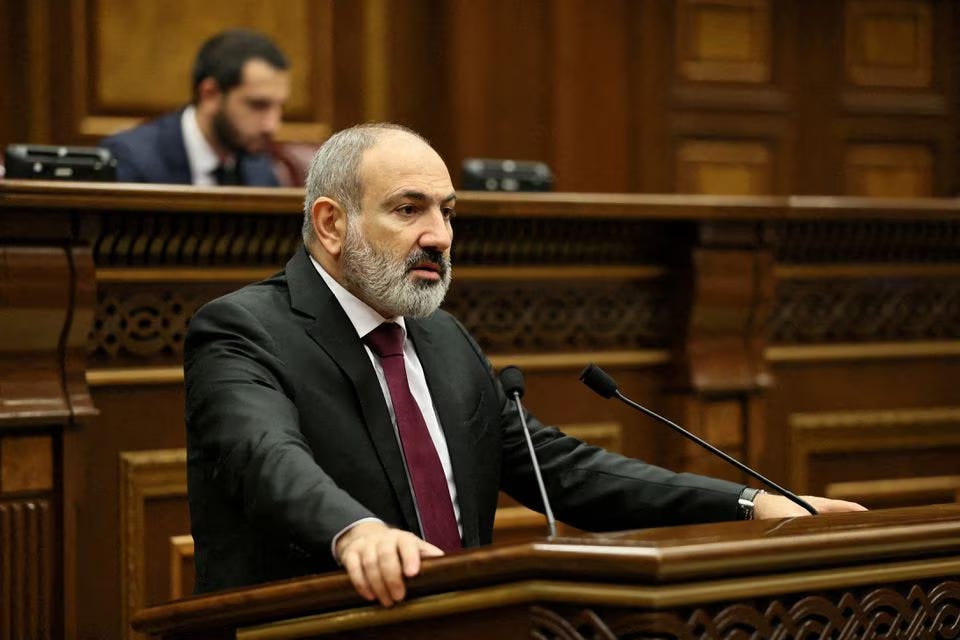
Armenia’s parliament has moved further away from its longtime Russian allies, voting to ratify the Rome Statute, and become a state party to the International Criminal Court (ICC). This move comes during the fallout of Azerbaijan’s lightning offensive against ethnic Armenians in Nagorno-Karabakh, which saw the capitulation of the separatist movement and mass exodus of the Armenian population from the enclave. It also saw Russian peacekeeping forces do nothing to help its Armenian allies.
This decision frustrates Russian leadership because President Putin has been indicted by ICC judges on war crimes stemming from the war in Ukraine, issuing warrants for his arrest. As a state party to the Rome Statute, Armenia is now obliged to arrest Putin if he crosses into Armenian territory. However, the Armenian government has extended to Russia a proposal in which Putin would still be able to visit Armenia without fear of arrest. Armenia’s stated primary reasoning for ratifying the Rome Statute is a response to Azerbaijan’s history of aggression and Armenian allegations of war crimes during the 2020 Nagorno-Karabakh War, wanting to make it clear that this move is not meant to antagonize Russia.
Regardless of whether Armenia would arrest Putin, this decision signals a strengthening in Armenia’s ties with the West and a further weakening in their relationship with Russia. The lack of Russian intervention in Azerbaijan’s takeover of Nagorno-Karabakh suggested that Armenia cannot and should not rely on Russia for defense. The Collective Security Treaty Organization did not seem to hold any real weight in coming to an ally’s defense or at the very least, helping to resolve the conflict.
Armenia is now faced with an emboldened Azerbaijan following their successful offensive. The departure of tens of thousands of Armenians from Nagorno-Karabakh will allow for easier governance for Baku and will eventually negate any valid reason for Russian peacekeepers to remain in the area, as they were sent in to deter Azeri incursions into the enclave and protect those who lived there. It is likely that this line of protection for Armenia will soon be no longer.
Additionally, Azerbaijan has signaled a desire to create a land corridor to the Nakhichivan Autonomous Republic, a strip of Azeri territory between Armenia, Türkiye, and Iran. Azerbaijan suggested this corridor would go through Armenia, which opposes the notion. The end goal of this land corridor would be to provide a link between Azerbaijan and Türkiye. These two countries share Turkic cultural and lingual ties.
Armenia, seemingly without the support of its strongest ally, seems to be in a transitionary phase between Russia and the West in search of more promising security and defense guarantees.
The move to the ICC is the latest step in recent months toward Europe and the West. In September, Armenia ran joint military exercises with the United States, drawing a strong rebuke from the Kremlin. Armenia pledged humanitarian aid to Ukraine. France has agreed on contracts to supply Armenia with military equipment. France has also called for the EU to defend the territorial integrity of Armenia.
The shift to the West is Armenia’s only real choice in finding a replacement for Russia in terms of a military alliance. Türkiye is closely allied with Azerbaijan, but Türkiye may be less likely to throw its full support behind Azeri pressure to create a land corridor to the Nakhichivan enclave or a future Azeri incursion into Armenian territory if the Armenians have the backing of NATO allies. The US has a history of imposing sanctions against Turkish entities in response to actions that go against American and NATO foreign policy. If NATO were to lend military support in the form of arms exports or security guarantees, then Türkiye and Azerbaijan may be wary of a Western response to an incursion.
Attempting to gain the favor of the West by antagonizing Russia is a dangerous game for Armenia to play. It currently does not have a viable security partner, and the United States and NATO have no real security interests in Armenia. A country breaking away from the Russian sphere of influence will always be a welcome sight for the Western allies, but a steadfast military alliance in the immediate future seems unlikely with NATO armaments and attention dominated by the war in Ukraine.
More than anything, the recent steps taken toward the West signify to Moscow that Armenia has more choices and that the West has an option to further extend its reach to another country right on the Russian border. Pashinyan may be trying to force Russia’s hand in reaffirming its commitment to its Armenian ally by suggesting it is in Russia’s best interest to remain allied with Armenia. He may also be trying to appeal to the West to gain support against Azerbaijan by shedding the notion that Armenia is a firm ally of Russia, therefore presenting as an ally of the West.
Regardless of intent, Armenia is in an exposed position where its defense capabilities are in limbo. Yerevan is drifting away from a distracted Moscow and reaching out toward a distracted West, while Azerbaijan remains focused on its objectives. The success of Pashinyan’s game relies heavily on now Russia and the West will respond.